The best CRM software is the one your reps will still use in month six. Not the one with the longest feature list, the biggest conference, or the most aggressive sales team. The one that makes the next action obvious, the data easy to trust, and the Monday pipeline review shorter than it was last quarter.
That definition sounds soft until you compare it with how most buyers shop. They start with a list of logos, watch three demos, and pick the one that felt the most impressive. The demo is a performance. Month six is the real test. This guide compares seven systems against the work a small or midsize US sales team actually does, and it tells you which one to shortlist for which situation.
How we compared them
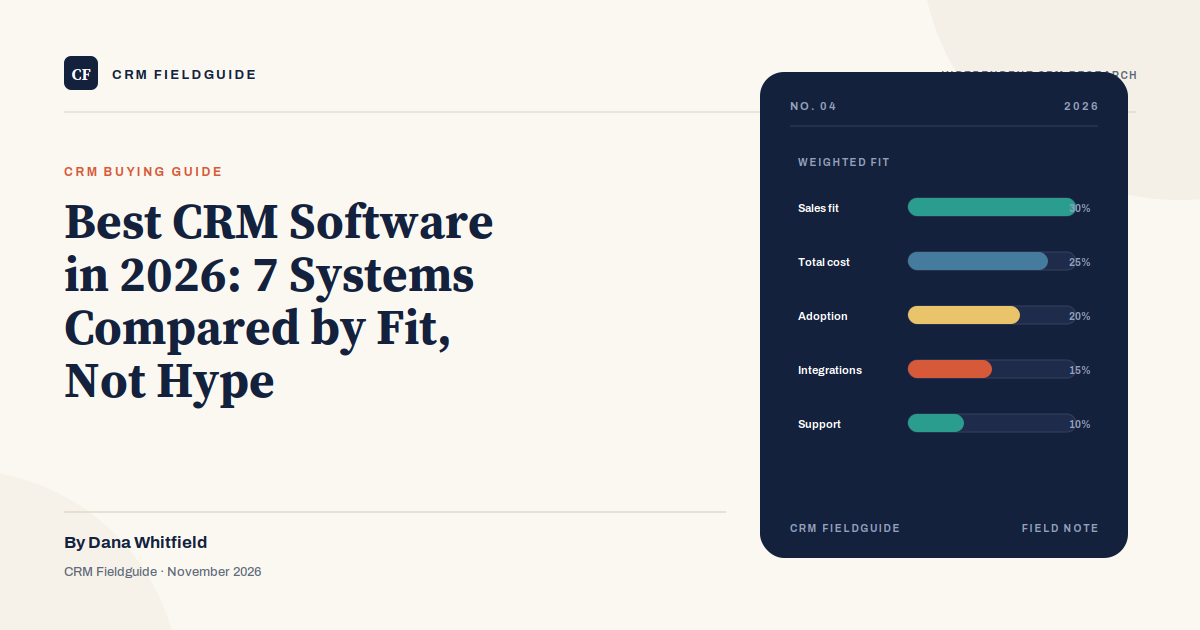
We scored each system on five weighted criteria. Sales fit gets the most weight because a CRM that cannot model your deal motion is a expensive address book. Total cost includes subscription, implementation, and the admin time the tool demands. Adoption is a judgment about how quickly a normal rep can use the product without a training course. Integrations cover email, calendar, ERP, and the data warehouse. Support and roadmap cover what happens when something breaks and whether the vendor is investing in the product.
The scores are based on published pricing and documentation, plus the experience of operators who use these tools every day. We do not run a timed lab test, and we do not pretend that a two-week trial reproduces a year of use. Where a conclusion depends on a negotiated contract or a company-specific integration, we say so. Prices are list prices published in late 2026; annual and negotiated rates vary.
The shortlist at a glance
| System | Best for | Entry price | Watch out for |
|---|---|---|---|
| HubSpot CRM | Inbound-led teams that want marketing and sales together | Free; paid from roughly $20/seat/month | Professional tier and onboarding fees |
| Salesforce | Complex, multi-team sales with customization needs | $25/user/month for Starter Suite | Implementation cost and admin burden |
| Pipedrive | Pipeline-first teams that want a simple sales tool | Roughly $14/user/month | Light marketing and service depth |
| Zoho CRM | Budget-conscious teams that want a broad feature set | Free for 3 users; paid from roughly $14/user/month | Interface complexity and feature sprawl |
| monday CRM | Teams already working inside monday.com | Roughly $12/seat/month, annual | Reporting depth and sales-specific depth |
| Freshsales | High-volume inside sales teams | Roughly $9/user/month | Smaller ecosystem and brand recognition |
| Capsule | Very small teams that want simple | Free for 2 users; paid from roughly $18/user/month | Limited scale and customization |
HubSpot CRM: best for inbound-led teams
HubSpot’s advantage is that marketing and sales share the same contact record without an integration project. Forms, landing pages, email campaigns, lead scoring, deals, and tasks live in one place, and the interface is the easiest to learn in this group. The free tier is genuinely usable for two people, and the Starter tier is a reasonable next step for a small team.
The catch is the jump to Professional. That is where contact tiers, onboarding fees, and hub bundles turn a $20-per-seat decision into a five-figure annual commitment. If your growth depends on content and inbound, the math often works. If you mainly need a pipeline, you are paying for a marketing engine you may not use. Read our full HubSpot review before you commit.
Salesforce: best for complex sales, worst for small budgets
Salesforce is the most capable platform on this list. Custom objects, record types, territories, approval processes, forecasting, permissions, and an enormous app ecosystem. If your sales process has multiple products, business units, channel partners, and a compliance team, Salesforce can model it without the workarounds that cheaper tools require.
It is also the easiest way to spend six figures on a 15-person team. Enterprise list price is $175 per user per month, and the implementation, admin, and add-on costs usually exceed the subscription in year one. Starter Suite at $25 per user per month is a different product with a different ceiling. Do not confuse the two. Our Salesforce review breaks down the real cost.
Pipedrive: best for pipeline-first teams
Pipedrive does one thing well: it shows a rep what to do next. The pipeline is visual, the activity-based selling model is built into the interface, and the setup takes days rather than weeks. For a team that sells a defined product to a defined buyer and does not need a marketing suite, it is often the fastest route to adoption.
The limits show up when the business gets more complex. Marketing automation, service tickets, and deep reporting are thinner than HubSpot or Salesforce. Pipedrive is a sales tool, not an operating system for the whole customer lifecycle. That is fine if sales is the bottleneck; it is a problem if you expect the CRM to run marketing and support too.
Zoho CRM: best value for budget-conscious teams
Zoho CRM gives you a broad feature set at a low price, and the free plan supports up to three users. The paid tiers add workflows, scoring, forecasting, and customization that would cost significantly more at HubSpot or Salesforce. For a cost-sensitive team with a patient admin, it is the best value on this list.
The trade-off is polish. Zoho’s interface is denser, the product line is sprawling, and the experience can feel like several tools stitched together. The free plan has record limits, and the paid tiers vary in what they include. If you have someone who enjoys configuration and does not mind a learning curve, Zoho is a strong choice. If you need a rep to be productive on day one, look at HubSpot or Pipedrive.
monday CRM: best for teams already on monday.com
monday CRM is a sales pipeline built on monday.com’s board engine. If your company already runs projects, marketing calendars, or operations in monday.com, the CRM lives in the same interface and connects to the same boards. The visual pipeline is easy to understand, and the automation builder is approachable for non-technical teams.
The product is less mature than the dedicated CRMs on this list. Reporting is improving but not as deep as Salesforce or HubSpot, and the board model can become messy when a sales process has many exceptions. It is a good fit for a small team that values flexibility and already pays for monday.com. It is a harder sell for a high-volume inside sales team. See our monday CRM review for the full picture.
Freshsales: best for high-volume inside sales
Freshsales is built for teams that make a lot of calls and work a lot of leads. It includes built-in phone, email, scoring, and workflow automation at a lower entry price than HubSpot or Salesforce. The interface is clean, and the Freddy AI assistant is useful for prioritizing leads and drafting follow-ups.
The ecosystem is smaller, and the product is less customizable than Salesforce. If your sales motion is primarily inbound and inside sales, Freshsales can be a strong value. If you need a large partner network, deep CPQ, or complex enterprise permissions, look elsewhere.
Capsule: best for very small teams
Capsule is the “just enough CRM” option. It is clean, fast, and designed for teams that do not want a configuration project. The free plan covers two users and 250 contacts, and the paid plans add more records, integrations, and reporting. For a two-person consultancy or a small B2B service business, it can be the most pleasant tool on this list.
The ceiling is low. Capsule is not built for complex pipelines, large teams, or heavy automation. If you expect to double the sales team in a year, choose a platform with more room to grow. If you want a simple system that does not demand an admin, Capsule is worth a trial.
The decision in one page
If you are inbound-led, start with HubSpot. If your sales process is genuinely complex, start with Salesforce. If you live in the pipeline and want simplicity, start with Pipedrive. If budget is the constraint and you have an admin, start with Zoho. If your company already runs on monday.com, start with monday CRM. If you run a high-volume inside sales desk, start with Freshsales. If you are two people and want a clean tool, start with Capsule.
What we would test in a trial
- Import 200 real records, including duplicates. Time the import and check how the system handles a company with three contacts and two deals. A demo with clean sample data hides the mess.
- Run one real deal through every stage. Include a lost deal and a deal that goes backward. The backward path is where most CRMs reveal their assumptions.
- Build the Monday report your manager will actually use. If it takes an admin and a custom integration, that is part of the cost.
- Log a call on your phone, in a parking lot, with one hand. Mobile adoption is a leading indicator of whether the CRM will survive.
- Export everything. Check what comes out, what is missing, and how long it takes. The export is your exit plan.
Frequently asked questions
What is the best CRM for a small business?
It depends on the sales motion. HubSpot is the best default for inbound-led teams, Pipedrive for pipeline-first teams, and Zoho for budget-conscious teams with an admin. There is no single best CRM for every small business.
What is the best free CRM?
HubSpot’s free CRM is the strongest for two users. Zoho CRM’s free plan supports three users and more records, but the interface is less polished. Both are permanent free tiers with limits, not trials.
Is Salesforce the best CRM?
It is the most capable platform for complex sales, but it is rarely the best fit for a small team without an admin and an implementation budget. “Best” depends on the process you need to run, not the size of the feature list.
How much should we budget for a CRM?
For a small team, plan on $20 to $100 per user per month for the subscription, plus implementation, admin time, and add-ons. The subscription is usually the smallest line in the first-year budget.
The verdict
Buy for the sales process you have, not the one you hope to have. A simple CRM that reps update after every call beats a powerful platform that only the admin understands. Shortlist two tools, test them with real data, and choose the one that makes the Monday review shorter. That is the only benchmark that survives month six.